
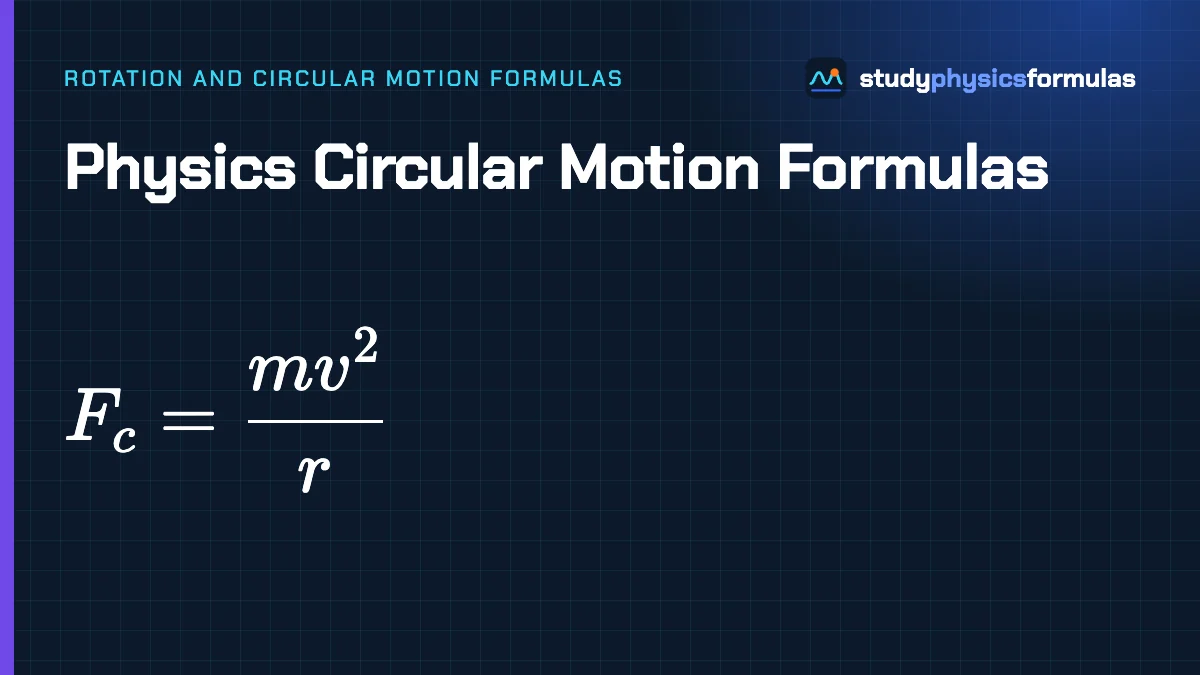
Physics circular motion formulas describe two linked ideas: a body travelling round a circle, and a body spinning about an axis. The single most used result is , the inward force a mass needs to stay on a circle, but it sits inside a larger family that covers angular velocity, torque, moment of inertia and angular momentum. In the Indian syllabus this material spans the Class 11 chapters on motion in a plane, laws of motion and rotational motion. In the US it forms the rotation units of AP Physics 1 and of the calculus based mechanics course.
This hub explains how those formulas connect, gives a table of the key results with links to a full page for each, and lists the traps that cost the most marks. Each linked page has a symbol table, worked examples and a solve-for calculator. If you are new to the topic, start with angular velocity, then work down the table in order.
Quick facts
Core link
Inward acceleration
Inward force
Rotational second law
Angular momentum
, conserved when net torque is zeroUnit of angle
Radian; every rotation formula assumes itCourses
Class 11, JEE, NEET, AP Physics 1 and C
How the physics circular motion formulas fit together
Picture the topic as a ladder with two rails. It starts from angles at the bottom and climbs to forces and torques at the top.
- Angle and spin rate. Angular displacement θ (in radians) changes at the rate . If ω itself changes, the rate is the angular acceleration α.
- Bridge to straight line motion. Multiply any spin quantity by the radius and you get its straight line partner: speed is ω times r, and the tangential acceleration is α times r.
- Branch one, curved paths. Any change of direction needs an inward centripetal acceleration equal to speed squared over radius, and Newton's second law turns it into the centripetal force .
- Branch two, spinning bodies. Mass is replaced by the moment of inertia I, force by torque τ, and linear momentum by angular momentum L. The laws keep the same shape: and .
- Where the body balances. The center of mass (spelled centre of mass in Indian syllabi) is the point whose motion represents the whole body, and the axis of free rotation passes through it.
Key formula table for circles and rotation
| Quantity | Formula | SI unit | Full page |
|---|---|---|---|
| Angular velocity | rad/s | Angular velocity | |
| Angular acceleration | rad/s² | Angular acceleration | |
| Inward (centripetal) acceleration | m/s² | Centripetal acceleration | |
| Radial acceleration | m/s² | Radial acceleration | |
| Tangential acceleration | m/s² | Tangential acceleration | |
| Centripetal force | N | Centripetal force | |
| Centrifugal force (rotating frame) | N | Centrifugal force | |
| Angle of banking | degree | Banking of road | |
| Moment of inertia | kg m² | Moment of inertia | |
| Radius of gyration | m | Radius of gyration | |
| Polar moment of a shaft | m⁴ | Polar moment of inertia | |
| I by bifilar suspension | kg m² | Bifilar suspension | |
| Torque | N m | Torque | |
| Angular momentum | kg m²/s | Angular momentum | |
| Electron spin, z part | J s | Spin angular momentum | |
| Balance point of a mass system | m | Center of mass | |
| Point where weight acts | m | Center of gravity |
Straight line and rotation, side by side
Most rotation formulas are copies of ones you already know. Learn the swap once and you have half the chapter.
| Rotational quantity | Plays the role of | Link between them |
|---|---|---|
| Angle θ | displacement s | arc s equals rθ |
| Angular velocity ω | velocity v | v equals ωr |
| Angular acceleration α | acceleration a | tangential part equals rα |
| Moment of inertia I | mass m | mass weighted by distance squared |
| Torque τ = Iα | force F = ma | lever arm times force |
| Angular momentum L = Iω | momentum p = mv | mvr for one particle |
| Spin energy, half Iω² | kinetic energy, half mv² | add both for a rolling wheel |
| Power τω | power Fv | watts in both |
The equations of motion carry over too: , and , valid while α is constant. They are the rotational twins of the results in the kinematics hub.
One problem, several formulas
Example: a stone in a sling
A 0.2 kg stone is whirled in a horizontal circle of radius 0.75 m. Starting from rest, the sling winds up evenly to 4 rev/s in 2 s. Find the final ω, the angular acceleration, the final speed, and the inward force at the end.
Final spin: .
Angular acceleration: . Tangential part: .
Final speed: .
Inward force at the end: .
Four pages of this section were used in four lines. That is typical of exam questions, which rarely test one formula alone.
Study plan for the rotation chapter
- Master radians first. Convert rpm with 2π/60 and revolutions with 2π before any other step.
- Learn the five standard moments of inertia (ring, disc, rod about centre and end, solid sphere) and the two axis theorems. Many JEE and NEET questions are these plus one step.
- Draw free body diagrams for every circular motion problem, and add the inward components of real forces only.
- Check conservation first. If no external torque acts, angular momentum is fixed and the problem often solves in one line.
- Practise mixed problems like the sling example, where speed, spin and force must all be found.
Gravity provides the inward force for planets and satellites, so the gravitation section is the natural next step after this one.
Exam traps in circular motion and rotation
- Adding a centripetal force arrow. It is the net inward force, not an extra one. Tension, friction, gravity or a normal force supplies it.
- Mixing frames. Use centripetal force from the ground or centrifugal force from the rotating frame, never both at once.
- Wrong r. Moment of inertia uses perpendicular distance from the axis; torque uses the lever arm; banking uses the radius of the curve.
- Thinking constant speed means zero acceleration. Uniform circular motion always has an inward acceleration.
- Quoting kinetic energy as conserved when a body changes shape. A skater pulling in her arms keeps L, not energy.
- Torque in joules. Torque and work share dimensions, but torque is written in N m.
Frequently asked questions
What are the main physics circular motion formulas?
The core set is v = ωr, ac = v²/r = ω²r, Fc = mv²/r and T = 2πr/v. For rotating bodies add I = Σmr², τ = Iα and L = Iω.
Which formulas from rotation are most important for Class 11?
Angular velocity and acceleration, the rotational equations of motion, centripetal force, the standard moments of inertia, the parallel and perpendicular axis theorems, torque, angular momentum and its conservation, and the center of mass formulas.
Why must angles be in radians in rotation formulas?
Relations such as v = ωr and s = rθ come from the definition of the radian as arc length over radius. With degrees they give wrong answers unless you add a conversion factor.
What is the difference between centripetal and centrifugal force?
Seen from the ground, a turning body has one inward net force, the centripetal force. A rider who turns with it instead adds an outward term, mω²r, called centrifugal force, which no other body actually exerts.
How are torque and angular momentum related?
Torque tells you how fast angular momentum changes, τ = dL/dt. Take the torque away and L has nothing to change it, so it stays fixed.