
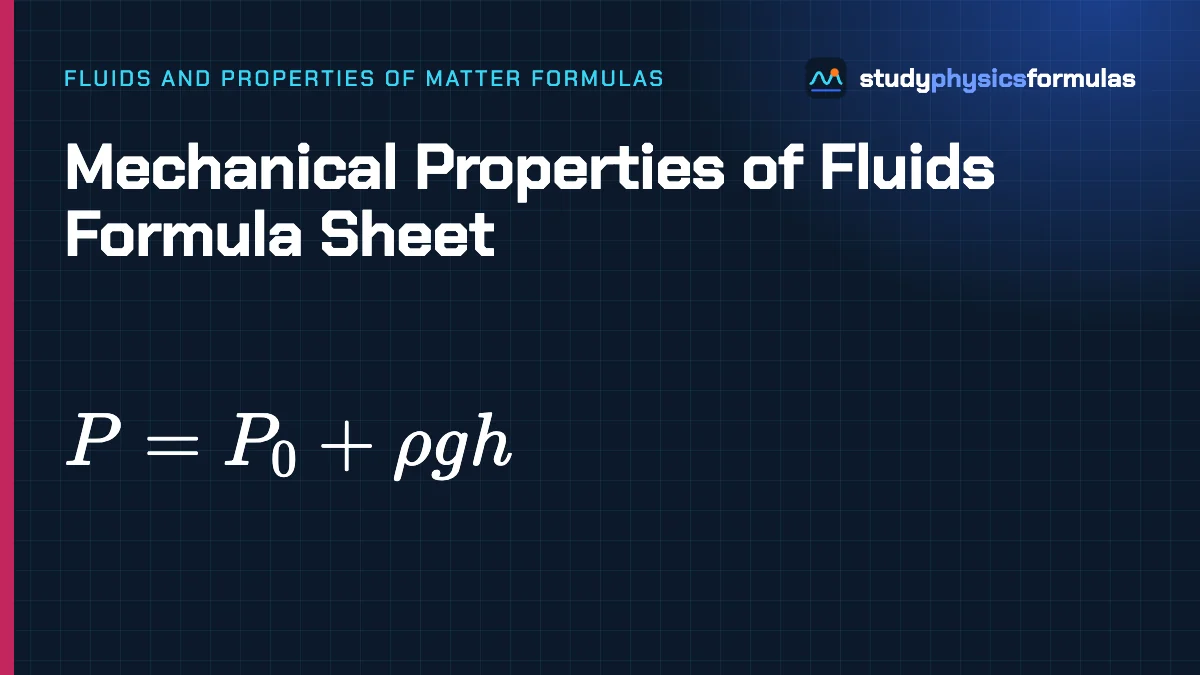
This mechanical properties of fluids formula sheet gathers every result you need for fluids at rest, fluids in motion, liquid surfaces and the elastic behaviour of solids, starting from the pressure at depth, . It follows the order of the Class 11 chapters on mechanical properties of fluids and of solids, and it also covers the fluids unit of AP Physics 2.
It is a study summary, not an official exam sheet. Boards and exam bodies set and supply their own formula lists where they allow one. Use the tables below to revise, and follow the links to the full pages for symbols, derivations and worked problems.
Quick facts
Hydrostatics
Buoyancy
Continuity
Bernoulli
Viscosity
Surface tension
Elasticity
How the mechanical properties of fluids formula sheet fits together
Think of the chapter as four connected blocks.
- Matter in bulk. Everything starts with density, mass per volume. Its cousins are relative density (compared with water), bulk density and tapped density (for powders and soils) and linear density (mass per metre of a string).
- Fluids at rest. Density times g times depth gives pressure. The pressure difference between the top and bottom of an object gives the buoyant force.
- Fluids in motion. Mass conservation gives the continuity equation, energy conservation gives Bernoulli's principle, and internal friction gives viscosity. Viscosity in turn sets the terminal velocity of falling spheres and the critical velocity where flow turns turbulent.
- Surfaces and solids. A liquid surface has surface tension and stores surface energy. A solid under load has stress and strain, and dividing one by the other gives a modulus of elasticity.
Notice how often one formula feeds the next. If you know where each one comes from, you rarely need to memorise more than a handful.
Density, pressure and buoyancy formulas
| Quantity | Formula | SI unit | Full page |
|---|---|---|---|
| Density | kg/m³ | Density | |
| Relative density | none | Relative density | |
| Bulk density | kg/m³ | Bulk density | |
| Linear density | kg/m | Linear density | |
| Pressure | Pa | Pressure | |
| Pressure at depth | Pa | Pressure | |
| Pascal's law (hydraulic lift) | N | Pressure | |
| Upthrust (buoyancy) | N | Buoyant force |
Pressure at a given depth does not depend on the shape of the container, and the buoyant force does not depend on what the object is made of. Both facts catch students out more than the formulas themselves.
Fluid flow and viscosity formulas
| Quantity | Formula | SI unit | Full page |
|---|---|---|---|
| Equation of continuity | is the same at every section | m³/s | flow rate Q = Av |
| Bernoulli's principle | Pa | energy per volume | |
| Speed of efflux (Torricelli's law) | m/s | hole at depth h | |
| Newton's law of viscosity | N | Viscosity | |
| Viscosity coefficient | Pa s | Coefficient of viscosity | |
| Velocity gradient | s⁻¹ | Velocity gradient | |
| Stokes' law | N | Viscous force | |
| Terminal velocity | m/s | Terminal velocity | |
| Reynolds number | none | Critical velocity |
For boats on moving water, the river's own speed is found with the speed of stream formula, a relative motion result that often turns up beside this chapter.
Surface tension and elasticity formulas
| Quantity | Formula | SI unit | Full page |
|---|---|---|---|
| Surface tension | N/m | Surface tension | |
| Surface energy | J | Surface energy | |
| Excess pressure, drop | Pa | Surface tension | |
| Excess pressure, soap bubble | Pa | Surface tension | |
| Capillary rise | m | Surface tension |
| Quantity | Formula | SI unit | Full page |
|---|---|---|---|
| Stress | Pa | Stress | |
| Strain | none | Strain | |
| Modulus of elasticity | Pa | Modulus of elasticity | |
| Young's modulus | Pa | Young's modulus | |
| Bulk modulus | Pa | Bulk modulus | |
| Modulus of rigidity | Pa | Modulus of rigidity |
All three moduli, stress and pressure share the dimensions [M¹ L⁻¹ T⁻²]. Step by step working sits on the pages for the dimensions of stress and the dimensions of surface tension.
Worked example: a pipe that narrows
Example: continuity and Bernoulli together
Water flows through a horizontal pipe whose cross section shrinks from 4.0 cm² to 1.0 cm². In the wide part the speed is 2.0 m/s. Find the speed in the narrow part and the pressure difference between the two parts.
Continuity: . The area ratio is the same in cm² or m², so no conversion is needed here.
Bernoulli with equal heights:
The pressure is 30 kPa lower in the narrow section, where the water moves faster.
Example: water from a tank
A tank is filled with water to 5.0 m above a small hole near its base. How fast does the water leave the hole?
This is the speed a stone would reach falling freely through 5.0 m.
Study tips and exam traps
- Gauge or absolute. ρgh is gauge pressure. Add P₀ only when the question asks for total pressure.
- Fluid density in buoyancy. The upthrust uses the density of the liquid, not the object.
- Radius, not diameter. Stokes' law, terminal velocity and capillary rise all take the radius.
- Two surfaces. Soap films and bubbles double the surface terms: F = 2TL, excess pressure 4T/r.
- Viscosity in poise. Convert to Pa s by dividing by 10.
- Mass is not force. Stress and pressure need a weight in newtons, m × g.
- Unit squares and cubes. a square centimetre is 10⁻⁴ m², a litre is 10⁻³ m³ and a cubic centimetre 10⁻⁶ m³.
- Sign of ΔV. In the bulk modulus formula ΔV is negative under compression; the minus sign keeps K positive.
A good revision routine is to cover the formula column of each table and write the formulas from memory, then check the units column without looking. If a unit will not come out right, the formula is wrong.
Frequently asked questions
What formulas are in the mechanical properties of fluids chapter?
The core set is P = P₀ + ρgh, Pascal's law, the buoyant force ρVg, the continuity equation, Bernoulli's principle, Torricelli's law, Newton's law of viscosity, Stokes' law, terminal velocity, Reynolds number and the surface tension results.
Can I take this page into an exam as my formula sheet?
Not for an exam hall. What you see here is a revision summary written for study. Each exam body decides whether to supply a list and what goes on it, so check yours and learn the rest by heart.
What is the most important formula for fluids at rest?
Pressure at depth, P = P₀ + ρgh. It explains hydraulic machines, dams, diving and, through the pressure difference on an object, the buoyant force.
Which formulas from mechanical properties of solids should I learn with fluids?
Stress = F/A, strain = ΔL/L, and the three moduli (Young's, bulk and rigidity). Bulk modulus also applies to liquids and gases.
Why do so many quantities here have the unit pascal?
Pressure, stress and all elastic moduli are force per unit area, or that divided by a dimensionless strain, so each has dimensions [M¹ L⁻¹ T⁻²] and the unit Pa.