
The work energy formula, , says that whatever net work the forces on a body do is exactly the amount by which its kinetic energy rises, or falls if that work is negative. Push a resting trolley with a net force through some distance and every joule of work you put in appears as a joule of kinetic energy. That single idea joins the two halves of this chapter: work, which is about forces acting through displacements, and energy, which is about what a body has because of its motion, position or shape.
Below you will find a map of how the chapter's formulas depend on each other, one summary table pointing to a dedicated page per result, a solved problem, and the study habits and traps that matter most. In India the material is the Class 9 work and energy chapter and the Class 11 work, energy and power chapter. In the US it is the energy unit of AP Physics 1. The same handful of equations runs through all of them.
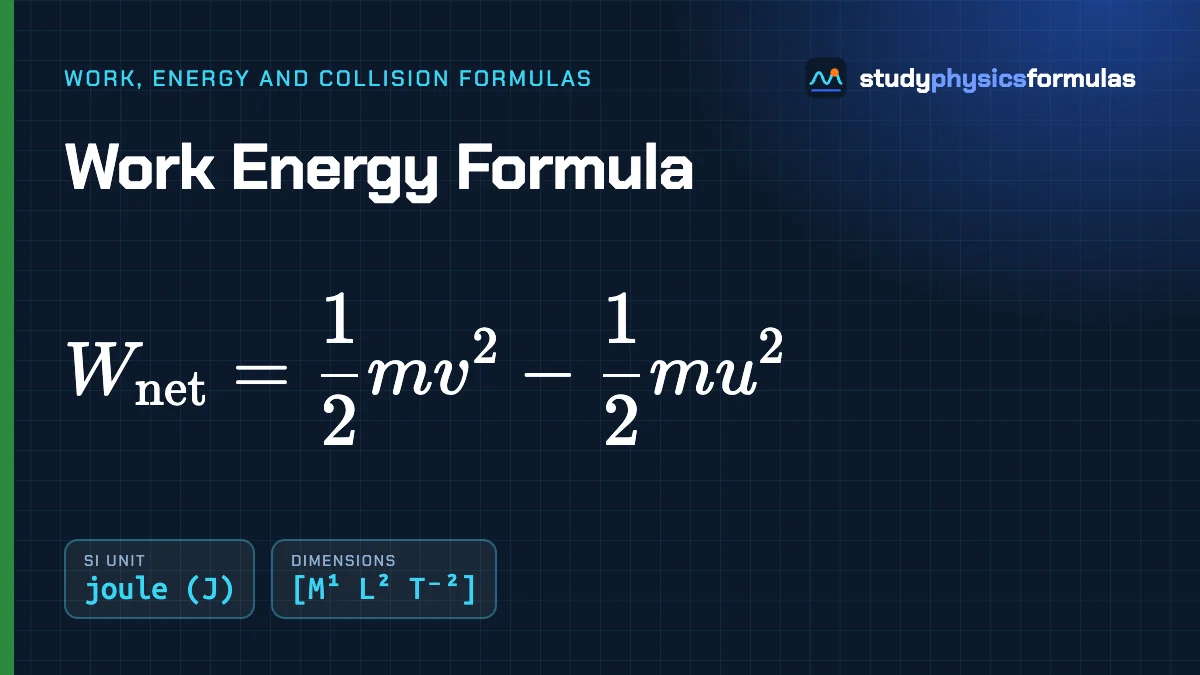
Quick facts
Work energy theorem
Work by a constant force
Kinetic energy
Potential energy
(gravity), (spring)SI unit
joule (J) for work and every form of energyDimensional formula
[M¹ L² T⁻²]Power
in watts (W)
How the work energy formula ties the chapter together
Think of the chapter as a short chain of ideas, each built on the one before.
- Work is how a force transfers energy: . See the work formula.
- Kinetic energy is the energy a body has because it moves, . See the kinetic energy formula.
- The work energy theorem links them: net work equals the change in kinetic energy. The work energy theorem formula page derives it from .
- Potential energy is a store for the work a conservative force, such as gravity or a spring, will do later. See the potential energy formula and the potential energy of spring formula.
- Conservation of energy follows: with only conservative forces, kinetic plus potential energy stays constant. See the conservation of energy formula.
- Non conservative forces such as friction remove mechanical energy as heat. See the work done by friction formula.
- Collisions test both momentum and energy. The coefficient of restitution says how much kinetic energy survives.
If you can explain each arrow in that chain in one sentence, you understand the chapter.
Key formulas with links
| Result | Expression | Unit | Read more |
|---|---|---|---|
| Work by a steady force | J | Work | |
| Work by a changing force | J | Work | |
| Energy of motion | J | Kinetic energy | |
| Stored energy of height | J | Potential energy | |
| Stored energy in a stretched spring | J | Spring energy | |
| Net work and speed change | J | Theorem | |
| Mechanical energy with no friction | J | Conservation | |
| Energy taken by sliding friction | J | Friction work | |
| Bounciness of a collision | no unit | Restitution | |
| Energy in its other forms | J | Energy | |
| Rate of doing work | W | this hub |
For the dimensions behind the joule, see the dimensional formula of work and the dimensional formula of energy. They are identical, which is the quickest proof that work and energy are the same kind of quantity.
A worked problem that uses the whole chain
A crate pushed across a rough floor
A 20 kg crate starts from rest. A worker pushes it 5.0 m across a level floor with a horizontal force of 120 N. The kinetic friction force is 60 N. Find the speed of the crate at the end.
Work by the push: W₁ = 120 × 5.0 = 600 J.
Work by friction: W₂ = −60 × 5.0 = −300 J.
Normal force and weight act at 90° to the motion, so they do no work.
The 300 J that friction took becomes heat in the floor and the crate.
Notice that the method never needed the acceleration or the time. That is the main advantage of energy methods: they skip straight from forces and distances to speeds. Newton's second law would give the same answer but with more steps.
Power: how fast the work is done
Two lifts may raise the same load through the same height, doing the same work, but the one that finishes faster is more powerful. Average power is , measured in watts, where 1 W = 1 J/s. For a force pushing an object at steady speed v in its own direction, .
A motor that lifts a 500 kg load through 12 m in 20 s does of work, so its useful power is 58 800 ÷ 20 = 2940 W, about 2.9 kW. The commercial unit of energy, the kilowatt hour, is one kilowatt for one hour, or 3.6 × 10⁶ J. Power and efficiency formulas are collected with the rest of the chapter on the work, power and energy formula sheet.
Study tips for work and energy
- Draw a free body diagram first. List every force, then ask which ones have a component along the motion. Only those do work.
- Choose energy or forces deliberately. If the question asks for a speed after a distance, energy is usually quicker. If it asks for a time or an acceleration, use the equations of motion.
- Write an energy bar chart. Before and after, list K, U and any heat. The bars must balance.
- Keep a single zero level for height through a whole problem.
- Check units at the end. Every term should be in joules; if one is in N or kg m/s, a factor is missing.
- Revise from a summary. The Class 11 physics formulas list, or the AP Physics 1 study sheet for US students, put this chapter next to the others in the course.
The spring force and friction force pages are worth revising alongside this chapter, since springs and friction appear in most energy questions. Momentum, which is conserved in every collision even when kinetic energy is not, is covered on the conservation of momentum page.
Exam traps in this chapter
- Calling the work done by friction positive. It opposes the motion, so it is negative.
- Saying a person holding a heavy box still does work on it. With no displacement, W = 0.
- Doubling the kinetic energy when the speed doubles. It goes up four times.
- Using total path length instead of height change in mgh. On a slope or curved track, only the vertical drop counts.
- Treating every collision as elastic. Momentum survives all collisions, but kinetic energy survives only the perfectly elastic ones.
- Writing torque in joules. Torque has units of N m but is not energy.
Frequently asked questions
What is the work energy formula?
Net work in, kinetic energy change out: W(net) = ½mv² − ½mu², where u is how fast the body moved before the work and v how fast afterwards.
Are work and energy the same thing?
They have the same unit, the joule, and the same dimensions, but they are not identical. Energy is something a body has; work is the process of transferring energy by a force acting through a displacement.
Which formulas should I memorise for the work and energy chapter?
W = Fd cos θ, K = ½mv², U = mgh, U = ½kx², W(net) = ΔK, K₁ + U₁ = K₂ + U₂ and P = W/t. Most problems use two or three of these together.
When should I use energy instead of Newton's laws?
Use energy when the question links speed with distance or height and does not ask for time. Use Newton's laws and the equations of motion when you need acceleration or time.
Which unit is power measured in?
The watt (W), equal to one joule per second. A kilowatt is 1000 W, and a kilowatt hour is an amount of energy, 3.6 × 10⁶ J.