
Here is all formula of electricity class 10 students need, in the order the chapter builds them: charge and current, potential difference, Ohm's law , resistance and resistivity, resistors in series and parallel, then electric power and the heating effect. Each one comes with a line on what it means, its unit, and where to go for solved problems on it.
The same ideas carry straight on into Class 12 and AP Physics, where you add electric fields, capacitors, drift velocity and magnetism. The second half of this hub lists those formulas too, so you can see where the Class 10 basics lead. If you only have an evening before a test, learn the first table and the exam traps section.
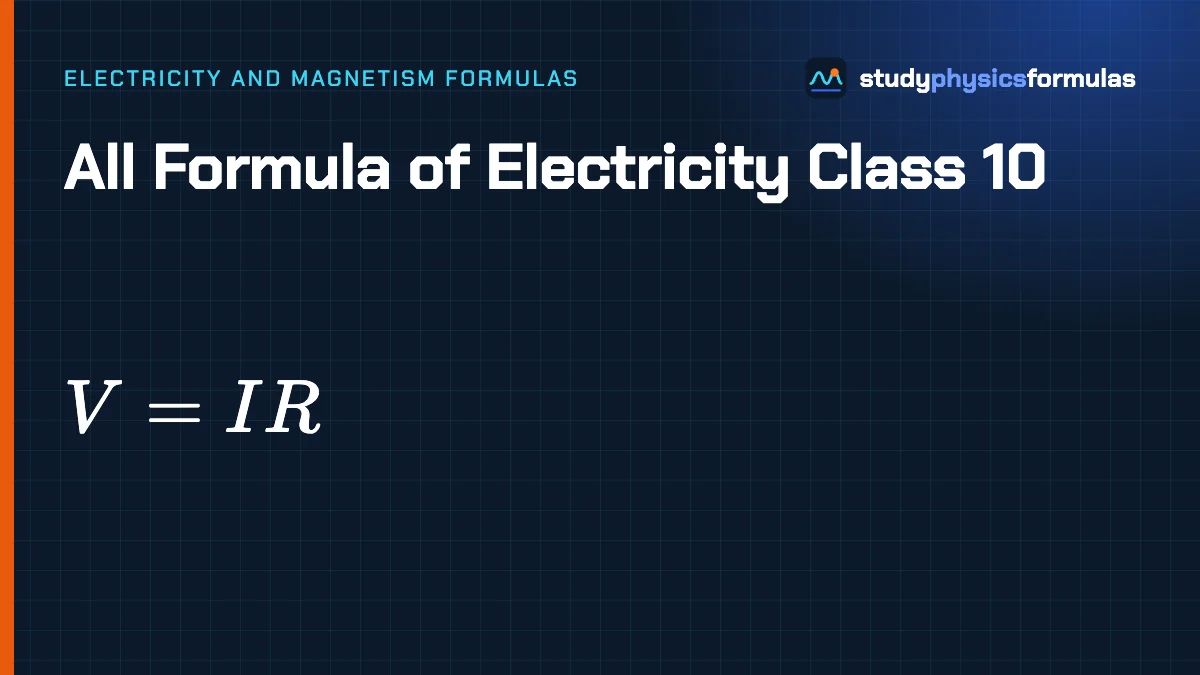
Quick facts
Core law
(Ohm's law)Current
Resistance of a wire
Power
Heating
Commercial energy unit
1 kW h = 3.6 × 10⁶ JCharge on an electron
1.602 × 10⁻¹⁹ C
How the electricity formulas fit together
Think of the chapter as one chain. Charge flowing per second is current. Energy given to each coulomb is potential difference. The ratio of the two is resistance, and the material and shape of a wire decide how big that ratio is. Multiply voltage by current and you get power, the energy used each second. Multiply power by time and you get the energy that shows up on an electricity meter or as heat in a wire.
So almost every numerical question in the chapter is a two step problem: use Ohm's law to find the missing one of V, I and R, then use a power or heat formula. Spot which link of the chain the question starts from and the route becomes clear.
All formula of electricity class 10 in one table
| Quantity | Formula | Unit | Read more |
|---|---|---|---|
| Electric current | ampere (A) | Current | |
| Charge from electrons | coulomb (C) | Charge | |
| Potential difference | volt (V) | Voltage | |
| Ohm's law | V, A, Ω | Ohm's law | |
| Resistance | ohm (Ω) | Resistance | |
| Resistivity | Ω m | Resistivity | |
| Series resistors | Ω | Combinations | |
| Parallel resistors | Ω | Combinations | |
| Electric power | watt (W) | Below | |
| Heat produced | joule (J) | Heat | |
| Electrical energy | J or kW h | Energy |
Series and parallel in practice
In a series circuit the same current flows through every resistor, and the voltages add up to the supply voltage. In parallel, every branch gets the full supply voltage, and the branch currents add up to the total. Household wiring is parallel so that each appliance gets the full mains voltage and can be switched on or off without affecting the others.
Example: a mixed circuit
Resistors of 4 Ω and 12 Ω are connected in parallel, and this pair is in series with a 2 Ω resistor across a 10 V battery. Find the current from the battery.
Total resistance = 3 + 2 = 5 Ω.
The voltage across the parallel pair is 2.0 × 3 = 6.0 V, so 1.5 A goes through the 4 Ω branch and 0.5 A through the 12 Ω branch.
Power, energy and heating
Electric power is the rate at which energy is transferred. Any of the three forms works, so pick the one that uses the values you are given: VI when you know both, I²R when current is known, V²/R when the voltage is fixed, as with mains appliances. A heater has a low resistance on purpose, because at fixed voltage a smaller R gives a larger V²/R.
Example: an appliance rating
A heater is rated 1000 W at 220 V. Find its current, its resistance and the energy it uses in 3 hours.
Energy = 1.0 kW × 3 h = 3.0 kW h = 1.08 × 10⁷ J.
The heat produced in a conductor, H = I²Rt, is used in electric irons, toasters, bulbs and fuses. A fuse wire has a low melting point so that a large current melts it before it can damage the wiring.
Beyond Class 10: formulas of electricity in physics for Class 12
Once you move to Class 12, JEE, NEET or AP Physics 2, electricity widens into electrostatics, current at the scale of electrons, and magnetism. These pages carry the story on:
| Topic | Main formula | Page |
|---|---|---|
| Force between charges | Electrostatic force | |
| Electric field | Electric field | |
| Charge densities | Charge density | |
| Capacitance | Capacitance | |
| Field energy | Energy density | |
| Drift of electrons | Drift velocity | |
| Current per area | Current density | |
| Cell emf | Electromotive force | |
| Field of a wire | Magnetic field | |
| Force on a current | Magnetic force | |
| Coil as a magnet | Magnetic moment | |
| Flux per area | Magnetic flux density |
For the whole Class 10 syllabus across all chapters, see the Class 10 physics formulas page.
Study tips for the chapter
- Learn the three quantities V, I and R together with their units and meters: voltmeter in parallel, ammeter in series.
- Write the given values with units before choosing a formula. The units often tell you which formula to use.
- For combination circuits, reduce parallel groups first, then add series parts, and redraw the circuit after each step.
- Practise ratio questions such as what happens to R when a wire is stretched to double its length. They are quick marks.
- Memorise that one kilowatt hour is 3.6 × 10⁶ J and that e = 1.602 × 10⁻¹⁹ C. Both appear often in numericals.
Exam traps in electricity numericals
- Parallel answers bigger than the smallest resistor. That is impossible; recheck your reciprocals and remember to flip 1/R at the end.
- Units of area. In R = ρL/A, mm² must become 10⁻⁶ m².
- Diameter versus radius. Doubling the diameter makes the area four times larger.
- Power of two bulbs. In series, the bulb with the higher resistance glows brighter, because I²R is larger for it. In parallel, the lower resistance bulb glows brighter, because V²/R is larger.
- Energy units. Convert watts to kilowatts and seconds to hours before giving an answer in kW h.
Frequently asked questions
What are all the formulas of electricity class 10?
I = Q/t, V = W/Q, V = IR, R = ρL/A, series R = R₁ + R₂ + …, parallel 1/R = 1/R₁ + 1/R₂ + …, P = VI = I²R = V²/R, H = I²Rt and E = Pt.
What is the most important formula of electricity?
Ohm's law, V = IR. Almost every circuit numerical uses it at least once, usually together with a power formula.
What is the formula of electricity in physics for power?
P = VI. Using Ohm's law it can also be written as P = I²R or P = V²/R.
How do I remember the series and parallel formulas?
Series resistors simply add. Parallel resistors add as reciprocals, and the combined value always comes out below the lowest individual resistance.
What is 1 kilowatt hour in joules?
1 kW h = 1000 W × 3600 s = 3.6 × 10⁶ J.
Which formula gives the heat produced by a current?
Joule's law of heating, H = I²Rt, which can also be written VIt or V²t/R.