
Physics kinematics formulas describe how things move without asking why they move, and the backbone of the whole chapter is with its two partners and . Kinematics comes before forces in almost every course, from Class 9 motion and Class 11 straight line motion in India to the first unit of AP Physics 1 in the US.
This hub lays out how the quantities depend on one another, which equation to pick for a given question, and the traps that examiners set again and again. Every row in the tables below links to a page with the full symbol list, worked examples and a calculator. Indian books write u for the starting velocity and s for displacement. US books usually write and . The physics is identical, so this page uses u and s and shows the US spelling once.
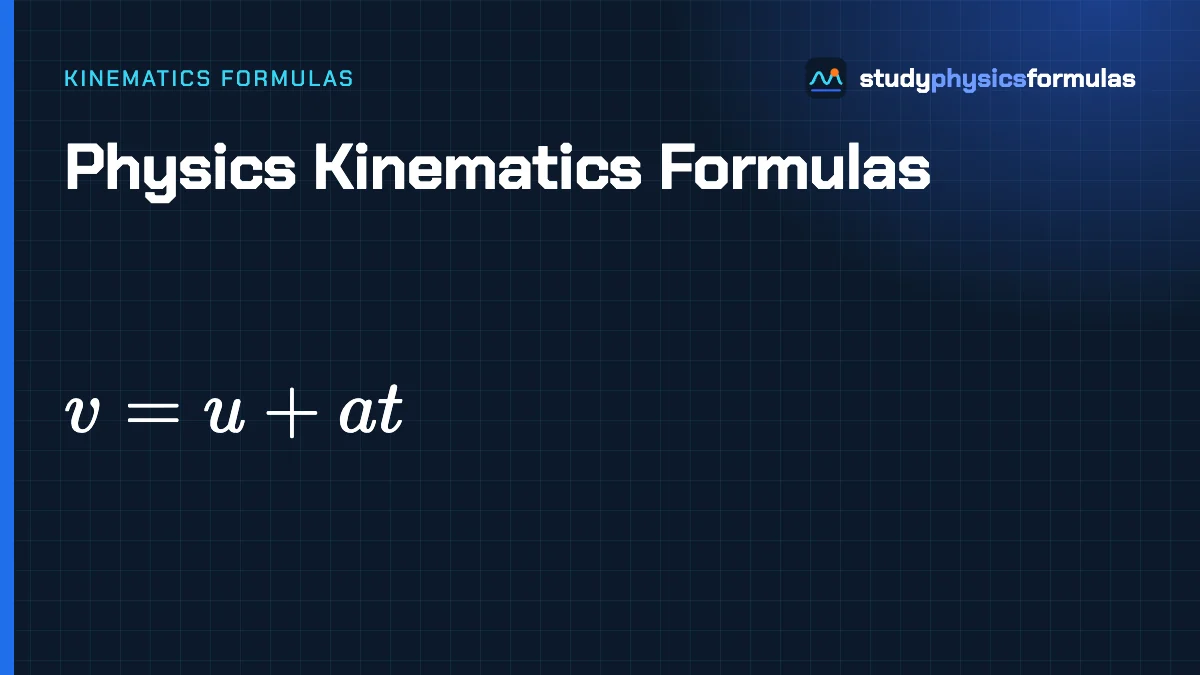
Quick facts
Core equations
, ,Condition
Valid only when the acceleration stays constant in size and directionChain of ideas
Position, then displacement, then velocity, then accelerationGraph rule
Slope of a graph gives the next quantity down the chain; area gives the one aboveFree fall
a = g = 9.8 m/s² downward (9.81 m/s² is also used)US symbols
,Courses
Class 9, Class 11, AP Physics 1, JEE Main, NEET
How the physics kinematics formulas fit together
Think of kinematics as a chain of four links. Each one is the rate of change of the one before it.
- Position says where the object is, measured from an origin you choose.
- Displacement is the change in position, a straight arrow from start to finish. See the displacement formula. The total path length is a different thing, the distance.
- Velocity is displacement per unit time, so it carries a direction. The velocity formula page covers , and the instantaneous velocity page covers the value at a single moment. Its size without direction is the speed.
- Acceleration is velocity change per unit time, built from the change in velocity. The acceleration formula is the last link.
Going down the chain means dividing by time, which on a graph is a slope. Going back up means multiplying by time, which on a graph is an area. Once you see this, the equations of motion stop looking like five separate facts. They are the same chain worked out for the one special case where the acceleration never changes.
The equations of motion and the variable each one leaves out
With constant acceleration there are five quantities: u, v, a, s and t. Each equation links four of them and leaves one out. Spot the quantity the question neither gives nor asks for, and pick the equation without it.
| Equation | Quantity it leaves out | Best used when |
|---|---|---|
| s, displacement | you need a velocity after a known time | |
| v, final velocity | you need how far it went in a known time | |
| t, time | no clock reading is given or wanted | |
| a, acceleration | both speeds and the time are known | |
| u, initial velocity | the end speed is given instead of the start |
Indian syllabi also ask for the displacement in the nth second, . It gives the metres covered during one particular second, not up to it. The first three equations each have their own page: the final velocity formula, the initial velocity formula and the constant acceleration formula, with the full set on the equations of motion page.
Key formula table for the motion chapter
| Quantity | Formula | SI unit | Full page |
|---|---|---|---|
| Speed | m/s | Speed | |
| Speed, distance and time | , | m, s | Triangle method |
| Time | s | Time | |
| Average speed | m/s | Average speed | |
| Average velocity | m/s | Average velocity | |
| Average acceleration | m/s² | Average acceleration | |
| Relative velocity | m/s | Relative velocity | |
| Linear velocity on a circle | m/s | Linear velocity | |
| Height fallen from rest | m | Height | |
| Time of flight | s | Time of flight | |
| Maximum height | m | Maximum height | |
| Horizontal range | m | Range |
The three projectile rows assume launch and landing at the same level, no air resistance, and measured from the horizontal. Mass does not appear anywhere in this table. A heavy ball and a light ball thrown the same way follow the same path when air drag is ignored. Mass only enters once forces do, which is the job of the laws of motion section and the mass formula .
Free fall and projectile motion as two straight lines
A projectile looks like a curve, but you solve it as two separate straight line problems that share the same clock.
- Horizontal: no force acts along it (ignoring air), so the horizontal velocity stays the same all the way.
- Vertical: the acceleration is g downward, so the vertical velocity starts at and falls by 9.8 m/s every second.
At the highest point the vertical velocity is zero, yet the horizontal part is still there, so the speed at the top is , not zero. For a fixed launch speed, the range is largest at 45°, and two angles that add to 90° (say 30° and 60°) give the same range. Straight up and down motion is just the special case , where the range is zero and the time of flight becomes .
Example: a cricket ball thrown straight up
A fielder throws a ball vertically upward at 19.6 m/s. Find the greatest height and the time until it comes back to the hand. Take g = 9.8 m/s².
Given: u = 19.6 m/s, v = 0 at the top, a = −9.8 m/s² (up is positive).
Time to the top: . The trip down mirrors the trip up, so the ball is back in the hand after 4.0 s.
Reading slopes and areas on motion graphs
| Graph | Slope gives | Area under it gives |
|---|---|---|
| Position against time | velocity | nothing useful |
| Velocity against time | acceleration | displacement |
| Acceleration against time | rate of change of acceleration (rarely asked) | change in velocity |
A straight sloping line on a velocity time graph means constant acceleration, and that is exactly when the equations of motion work. A curved velocity line means the acceleration is changing, so you must find the area by counting squares or splitting it into triangles and rectangles. Area below the time axis counts as negative displacement. Add the signed areas for displacement, and add the sizes for distance.
Example: braking distance with km/h
A scooter moving at 54 km/h brakes with a steady retardation of 3.0 m/s². How far does it travel before stopping, and how long does it take?
Convert: 54 km/h × (1000 m ÷ 3600 s) = 15 m/s. So u = 15 m/s, v = 0, a = −3.0 m/s².
Time: . Check with the average speed: , so both routes agree.
Exam traps that cost students marks in kinematics
- Using the five equations when a is not constant. A question with or a curved graph needs the definitions or calculus, not .
- Losing the sign of g. Choose up or down as positive at the start and keep it. If up is positive, g enters as −9.8 m/s² even while the ball is still rising.
- Averaging two speeds. A bus that covers equal distances at 40 km/h and 60 km/h averages 48 km/h, not 50 km/h, because it spends longer at the lower speed. Use total distance over total time.
- Treating distance and displacement as the same. After one full lap of a 400 m track, distance is 400 m but displacement is zero, so average velocity is zero too.
- Measuring the launch angle from the vertical. The projectile formulas take from the horizontal. If the question gives the angle with the vertical, use .
- Saying the projectile stops at the top. Only the vertical component is zero there.
- Mixing units. Bring km/h, cm and minutes into m/s, m and s before you substitute anything.
For revision, rewrite the five equations from memory, then cover the middle column of the first table and say which variable each one drops. Ten minutes of that is worth more than rereading the chapter.
Frequently asked questions
What are the main physics kinematics formulas?
The core set is v = u + at, s = ut + ½at² and v² = u² + 2as, plus s = (u + v)t / 2. Add speed = distance / time and the projectile results for time of flight, maximum height and range.
When can I use the equations of motion?
Only when the acceleration is constant in size and direction for the whole interval. Free fall near Earth with air resistance ignored is the most common example. If the acceleration changes, split the motion into parts or use graphs.
What is the difference between speed and velocity?
Speed is distance per unit time and has no direction, so it is a scalar. Velocity is displacement per unit time and has a direction, so it is a vector. A car going round a roundabout at a steady 10 m/s has constant speed but changing velocity.
Why does mass not appear in kinematics formulas?
Kinematics only describes motion. When air resistance is ignored, every object near Earth falls with the same acceleration g, so its mass cancels out. Mass becomes important once you study the forces that cause the motion.
How do I choose which equation of motion to use?
List the five quantities u, v, a, s and t. Mark the three you know and the one you want. The equation that leaves out the fifth quantity is the one to use.