
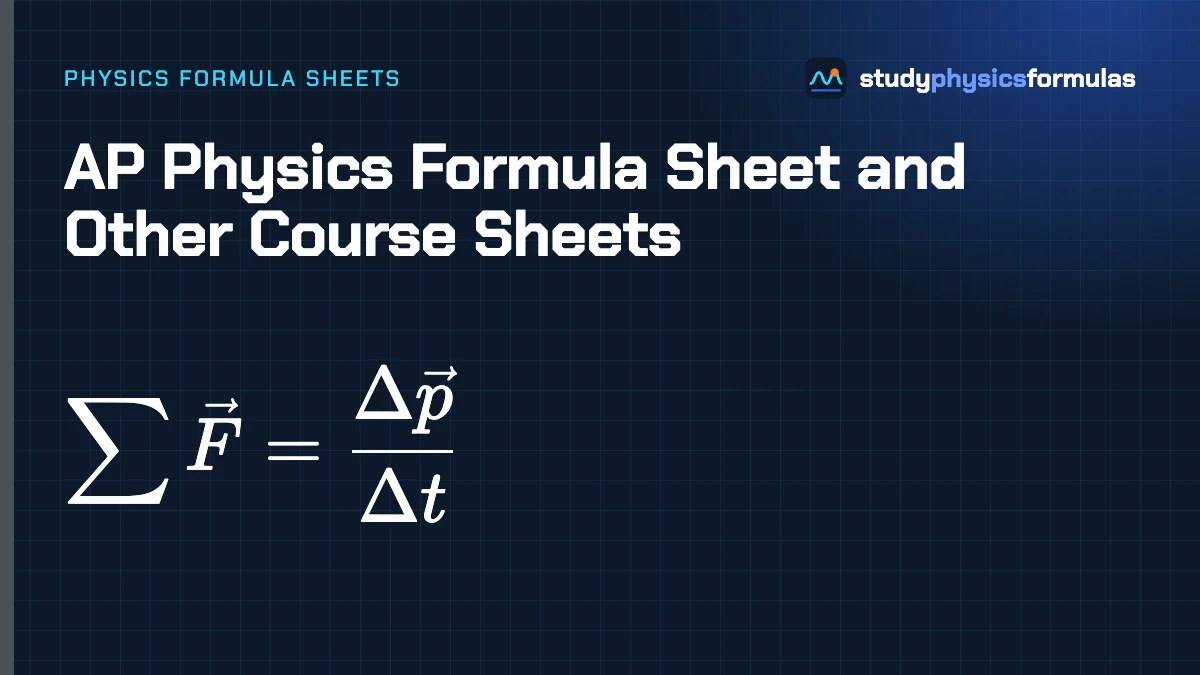
An AP physics formula sheet is the table of equations and constants that the exam board provides with each AP physics exam, and the line that holds most of mechanics together on it is Newton's second law in momentum form, . This hub explains what such sheets contain, which course each of our study summaries covers, and how the equations link up from one topic to the next.
None of the pages here is an official sheet. Each one is a study summary that adds what an exam table leaves out: what every symbol means, the SI unit, the conditions for use and a worked example. Alongside the four AP courses, the same section covers Indian school and entrance courses, from Class 10 to JEE Main and NEET, plus the IB Diploma. Whichever physics formula sheet AP or board students need, start from the course table below.
Quick facts
Official sheets
Provided by the exam board or awarding bodyThese pages
Study summaries with meanings, units and examplesAP courses
AP Physics 1, AP Physics 2, AP Physics C: Mechanics, AP Physics C: E&MIndian courses
Class 10, 11 and 12, NEET, JEE MainAlso covered
IB Diploma physics, chapter sheetsMost shared law
What an AP physics formula sheet contains
Each AP physics exam comes with its own equation tables. Their layout changes from time to time, but in general terms they hold four kinds of content:
- Constants and conversion factors, such as the gravitational constant, the charge of an electron and the speed of light.
- Unit prefixes from nano to giga, and sometimes values of common trigonometric functions.
- Equations grouped by topic, with a short key to the symbols.
- Geometry, such as the area of a circle or the volume of a sphere.
The sheets for AP Physics 1 and 2 use algebra and trigonometry. The two AP Physics C sheets write many relations as derivatives and integrals. What no formula sheet AP physics students receive will do is tell you which equation fits a situation, or warn you that a relation holds only for constant acceleration or an isolated system. That judgement is what the free response questions reward, and it is what the study pages linked below try to build.
Choose your course
| Course or chapter | Math level | Main content | Page |
|---|---|---|---|
| AP Physics 1 | algebra | kinematics, forces, energy, momentum, rotation, oscillations, fluids | AP Physics 1 sheet |
| AP Physics 2 | algebra | thermodynamics, electricity, magnetism, optics, waves, modern physics | AP Physics 2 sheet |
| AP Physics C overview | calculus | how the two C courses fit together | AP Physics C sheet |
| AP Physics C: Mechanics | calculus | mechanics with variable forces, rotation and drag | C Mechanics sheet |
| AP Physics C: E&M | calculus | Gauss's and Ampère's laws, circuits, induction | C E&M sheet |
| Class 10 | algebra | light, the eye, electricity, plus a Class 9 table | Class 10 formulas |
| Class 11 | algebra, some calculus | fourteen chapters from measurement to waves | Class 11 chapter wise |
| Class 12 | algebra, some calculus | electrostatics to semiconductors | Class 12 sheet |
| NEET | algebra | high yield NCERT formulas and ratio shortcuts | NEET sheet |
| JEE Main | calculus | derived results, rolling, errors, multi concept problems | JEE Main sheet |
| IB Diploma | algebra | five themes from motion to quantum physics | IB booklet guide |
| Chapter sheet | algebra | photons, photoelectric effect, matter waves | Dual nature sheet |
| Chapter sheet | algebra | work, energy, power and collisions | Work power energy sheet |
If you are unsure where to begin, start with the algebra based mechanics sheet for your course. Mechanics underpins every later topic, and both Indian and US courses teach it first.
How the formulas fit together
A formula sheet looks like a long list, but the physics behind it is a short chain of ideas. Read it as a concept map in words:
- Motion is described by position, velocity and acceleration. Slopes and areas of graphs link them.
- Forces cause changes in motion: , or more generally the rate of change of momentum.
- Energy and momentum are two shortcuts around force. Work changes kinetic energy; impulse changes momentum.
- Rotation repeats the same structure with torque, rotational inertia and angular momentum.
- Fields carry forces at a distance. Gravity and electricity both follow inverse square laws, so their field and potential formulas look alike.
- Waves and light share ; optics adds refraction and lens equations.
- Quantum ideas link waves and particles through and .
When you meet a new equation, place it on this chain. It is far easier to remember a formula as a step in a story than as an isolated line.
Formulas that appear on almost every physics formula sheet
| Equation | Idea | SI unit | Full page |
|---|---|---|---|
| Newton's second law | N | Net force | |
| velocity with constant acceleration (US: v = v₀ + at) | m/s | Final velocity | |
| how quickly velocity changes | m/s² | Acceleration | |
| kinetic energy of a moving mass | J | Kinetic energy | |
| energy stored by height | J | Potential energy | |
| momentum | kg m/s | Momentum | |
| turning effect of a force | N m | Torque | |
| pull between any two masses | N | Gravitational force | |
| Coulomb's law for charges A and B | N | Electrostatic force | |
| potential difference across a resistor | V | Ohm's law | |
| speed of a wave from its frequency and wavelength | m/s | Wave velocity | |
| photon energy | J | Modern physics |
Example: one force, two methods
A catcher's glove brings a 0.20 kg ball moving at 15 m/s to rest in 0.040 s. What average force does the glove exert? Work it out from momentum, then check it with acceleration.
Momentum: , so .
Acceleration: and .
Answer: 75 N opposite to the motion. Both routes give the same result because they are the same law.
Constants you will see again and again
| Constant | Symbol | Value |
|---|---|---|
| Acceleration due to gravity | g | 9.8 m/s² (9.81 also used) |
| Gravitational constant | G | 6.674 × 10⁻¹¹ N m²/kg² |
| Speed of light | c | 3.00 × 10⁸ m/s |
| Elementary charge | e | 1.602 × 10⁻¹⁹ C |
| Planck's constant | h | 6.626 × 10⁻³⁴ J s |
| Boltzmann constant | k_B | 1.381 × 10⁻²³ J/K |
| Electric constant (permittivity of free space) | ε₀ | about 8.854 × 10⁻¹² C²/(N m²) |
| Magnetic constant (permeability of free space) | μ₀ | close to 4π × 10⁻⁷ T m/A |
Use the value the question or the exam table gives. If it gives none, these are the standard choices. Carry one or two extra figures through the working and round only at the end.
Study tips for any formula sheet
- Practise with the real thing. Download the current official sheet for your exam and keep it beside you for every practice set, so you know where each line sits.
- Write a symbol key in your own words. For each equation, note what each letter means in a typical diagram.
- Learn the conditions. Constant acceleration, isolated system, ideal gas, small angle, thin lens: each formula has one.
- Check units on every answer. A quick unit check catches most algebra slips.
- Learn the definitions the sheet leaves out. Sheets list relations, not meanings, so the definition of work, flux or impulse is on you.
Exam traps that cost marks
- Using a constant acceleration equation when the force changes. If a varies, integrate or use energy.
- Mixing sign conventions. US courses and NCERT treat lens and mirror distances and the first law of thermodynamics differently. Stick to one per problem.
- Forgetting unit conversions. Grams, centimetres, km/h, μC and nm cause more lost marks than wrong formulas.
- Treating vectors as scalars. Forces, fields and momenta add with direction; energies and potentials do not.
- Calculator in degree mode for radians. Angular speed and SHM formulas need radians.
For the units behind every formula, the dimensional formulas hub is a good companion, and the kinematics hub walks through the first topic of every course.
Frequently asked questions
Is there an official AP physics formula sheet?
Yes. The exam board publishes equation tables for each AP physics exam and provides them during the exam. The pages in this section are study summaries, not those official tables.
Do AP Physics 1 and AP Physics 2 share one sheet?
No. Each course has its own sheet that matches its content, although shared constants and some mechanics relations appear on both. The C courses have their own calculus based tables.
Do Indian board exams, NEET or JEE give a formula sheet?
These exams do not usually supply a formula sheet, so students must know the formulas. Always check the current rules for your exam.
What should I memorise if I get a formula sheet?
Definitions, the meaning of each symbol, the conditions for each equation, standard graphs and the main derivations your course asks for.
Which physics formula sheet should a beginner start with?
Start with the mechanics sheet for your course: AP Physics 1 in the US, or the Class 11 chapter wise list in India. Mechanics comes first in every syllabus.