
The wave velocity formula is : the speed of a wave equals its frequency multiplied by its wavelength. Every wave obeys it, from a ripple on a pond and a note from a guitar string to the light that reaches your eye from a lamp. It is the first equation to learn in the waves chapter and the one that ties the rest together.
This hub covers two linked topics. The first is waves: frequency, period, wavelength, amplitude, intensity and the speeds of sound and light. The second is ray optics: refraction, mirrors, lenses and prisms. Optics belongs here because the index of refraction is just a ratio of two wave speeds. Read the concept map below, use the table to jump to any page, and finish with the traps section before a test. Indian students meet this material in Class 9 sound, Class 10 light, Class 11 waves and Class 12 ray optics. In the US it sits in the waves unit of AP Physics 1 and the optics unit of AP Physics 2.
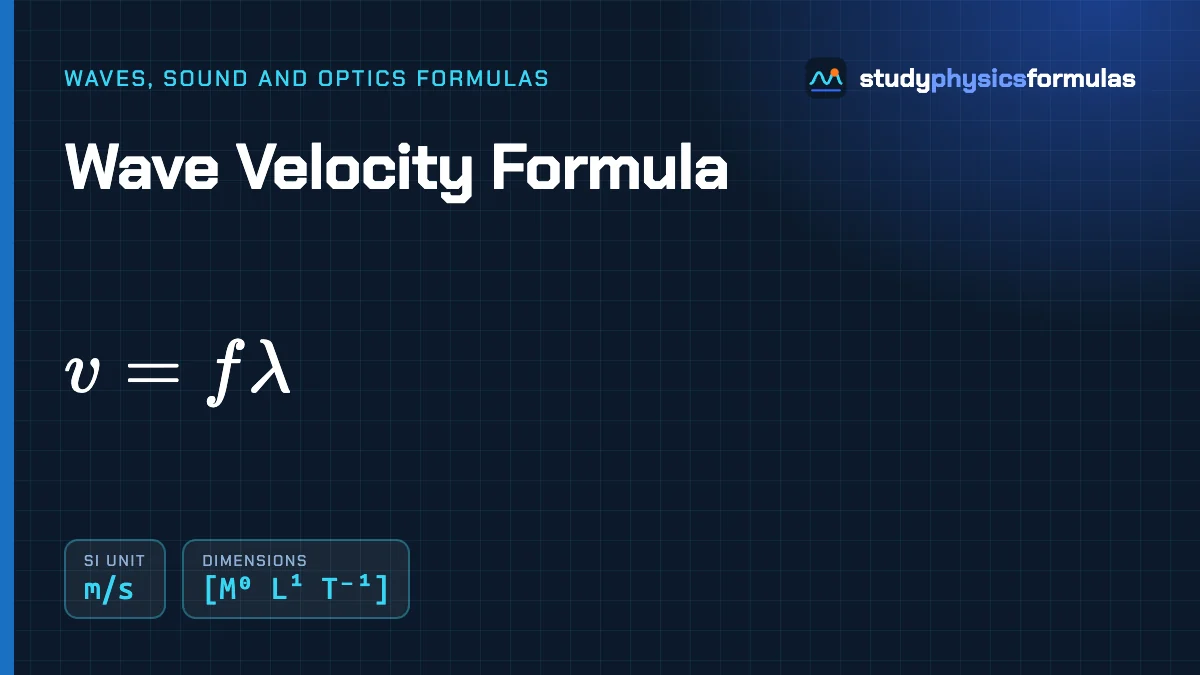
Quick facts
Formula
, also writtenSI unit
metre per second (m/s)Dimensional formula
[M⁰ L¹ T⁻¹]Set by
The medium, not the source: tension and mass per length for a string, elasticity and density for soundUnchanged on refraction
Frequency stays the same when a wave enters a new medium; speed and wavelength changeLight in vacuum
c = 3.00 × 10⁸ m/sCourses
Class 10 to 12, AP Physics 1 and 2, JEE, NEET
How the wave velocity formula links the whole chapter
A wave is a travelling disturbance that carries energy without carrying the medium along with it. Four numbers describe a steady wave, and three of them are joined by one equation.
- Period T is the time for one full oscillation at a point. See the period formula.
- Frequency f is the number of oscillations per second, so . See the frequency formula.
- Wavelength λ is the distance between two neighbouring crests. See the wavelength formula.
- Amplitude A is the largest displacement from the rest position. It does not appear in at all, but it controls the energy, as the amplitude formula page explains.
In one period the wave moves forward by one wavelength. Speed is distance over time, so . That one line is the derivation most exams expect. Energy enters through intensity, which grows with the square of the amplitude and falls with the square of the distance from a point source.
Speed of a wave in different media
The formula tells you how the three quantities relate. It does not tell you what decides the speed. That comes from the medium, and each type of wave has its own speed formula.
| Wave | Speed formula | Depends on |
|---|---|---|
| Transverse wave on a string | Tension T (N) and mass per unit length μ (kg/m) | |
| Sound in a gas | Pressure, density and the ratio of specific heats γ | |
| Sound in a solid rod | Young's modulus Y and density ρ | |
| Light in vacuum | Two constants of electricity and magnetism | |
| Light in a material | Refractive index n of the material |
The speed of sound formula page works through the gas case, including why sound is faster on a warm day. The speed of light formula page shows where 3.00 × 10⁸ m/s comes from. In each case a stiffer medium gives a faster wave and a heavier medium gives a slower one.
Key wave and optics formulas with links
| Formula | What it gives | Unit | Page |
|---|---|---|---|
| Wave speed | m/s | this hub | |
| Frequency | Hz | Frequency | |
| Time period | s | Period | |
| Wavelength | m | Wavelength | |
| Displacement, amplitude A | m | Amplitude | |
| Intensity | W/m² | Intensity of wave | |
| Speed of sound in a gas | m/s | Speed of sound | |
| Speed of light | m/s | Speed of light | |
| Refractive index | no unit | Index of refraction | |
| Where a mirror forms the image | m | Mirror formula | |
| Mirror magnification | no unit | Magnification of mirror | |
| Where a lens forms the image | m | Lens formula | |
| Lens magnification | no unit | Magnification of lens | |
| Power of a lens | D | Power of lens | |
| Focal length from glass and curvature | m | Lens maker | |
| Deviation by a prism | degree | Angle of deviation | |
| Silvered lens as a mirror | D | Silvering of lens |
Worked examples using the velocity of wave formula
Example 1: ripples in a tank
A dipper vibrates 12 times per second and the ripples it makes are 2.5 cm apart. Find the wave speed.
Given: f = 12 Hz, λ = 2.5 cm = 0.025 m.
The ripples cross the tank at 0.30 m/s, or 30 cm every second.
Example 2: a string under tension
A guitar string has mass per unit length 5.0 g/m and is held at a tension of 80 N. It vibrates at 200 Hz. Find the wave speed and the wavelength on the string.
Convert first: μ = 5.0 g/m = 5.0 × 10⁻³ kg/m.
Keep the unrounded speed, 126.5 m/s, for the second step so the wavelength stays accurate.
How ray optics grows out of wave speed
Light slows down in glass and water. The ratio of its speed in vacuum to its speed in a material is the refractive index, . Because the frequency is fixed, a slower speed means a shorter wavelength inside the material. When a beam meets the surface at an angle, one side of the wavefront slows before the other and the beam bends. That bending is refraction, described by Snell's law .
Lenses and prisms are just shaped pieces of glass that use refraction. The lens maker formula turns the curvature and the refractive index into a focal length. The lens formula then turns the focal length into an image position, and lens power in dioptres is the same focal length written as 1/f. Mirrors use reflection instead, so their formula has no refractive index in it. A silvered lens mixes both: light refracts in, reflects at the coated face and refracts out again. A prism bends light by an angle of deviation that depends on the refractive index, which is why white light spreads into colours.
Sign conventions for mirrors and lenses
All optics pages on this site use the New Cartesian sign convention found in Indian Class 10 and Class 12 books. Distances are measured from the pole of the mirror or the optical centre of the lens. Distances in the direction of the incident light are positive, and distances against it are negative. Heights above the principal axis are positive.
With this convention the object distance u is almost always negative, a concave mirror has a negative focal length, a convex lens has a positive focal length, and the formulas take the forms in the table above. Several American courses prefer to treat real distances as positive and write the mirror and thin lens equation as instead. Both give the same physical answer. The trouble starts only when a student mixes them in one problem, so pick one and stay with it.
Study tips and exam traps for waves and optics
- Frequency belongs to the source. A wave entering water from air keeps its frequency. Only v and λ change.
- Amplitude does not change the speed. A louder note travels at the same speed as a soft one.
- Convert wavelengths. Light wavelengths come in nanometres (1 nm = 10⁻⁹ m) and sound wavelengths often in centimetres.
- Power of a lens needs metres. A focal length of 20 cm gives 1/0.20 = 5 D, not 1/20.
- Mirror and lens formulas differ by one sign. The mirror formula adds 1/v and 1/u, the lens formula subtracts. Mirror magnification carries a minus sign, lens magnification does not.
- Angles in Snell's law are measured from the normal, not from the surface. A 30° angle with the surface is 60° with the normal.
- Doubling the distance quarters the intensity from a point source, because the energy spreads over a sphere of area .
For revision, write the table in this hub from memory, then check it. Students who can rebuild the table can usually handle any numerical question in the chapter. The dimensional formula of frequency and the dimensional formulas hub help you check rearrangements quickly.
Frequently asked questions
What is the formula of wave velocity?
Wave velocity equals frequency times wavelength, v = fλ. You can also write it as v = λ / T, since the wave moves one wavelength in one period.
What is the SI unit of wave speed?
The SI unit is the metre per second (m/s). Frequency in hertz (per second) multiplied by wavelength in metres gives metres per second.
Does wave speed depend on frequency?
For sound in air and light in vacuum, no: all frequencies travel at the same speed, so a higher frequency means a shorter wavelength. In a material such as glass, light speed does depend slightly on frequency, which causes dispersion in a prism.
What is the difference between wave velocity and particle velocity?
Wave velocity is how fast the pattern moves through the medium. Particle velocity is how fast one bit of the medium moves as it oscillates about its rest position. They are different quantities and are often in different directions.
Why is the speed of a wave formula the same for sound and light?
Because v = fλ only uses the idea that a wave advances one wavelength per period. That is true for any repeating wave, whatever it is made of. What differs between sound and light is the value of v, which the medium decides.