
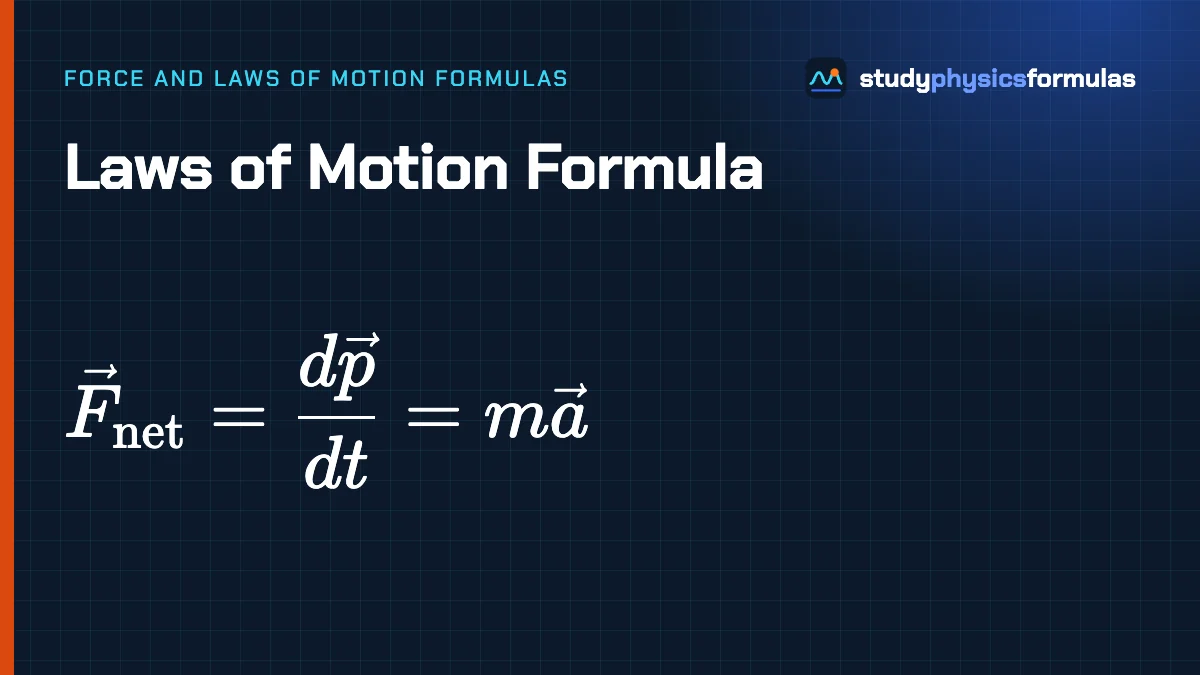
The central laws of motion formula is , which says the total force on a body sets how fast its momentum changes; for a body of fixed mass that is its mass times its acceleration. Around this one equation sit the first law, which covers the case of zero net force, and the third law, which says forces always come in equal and opposite pairs.
Newton's three laws turn up in Class 9 force and laws of motion, Class 11 laws of motion, and the dynamics units of AP Physics 1. This hub sets out the 3 laws of motion formula by formula, shows how friction, tension, momentum and impulse grow out of them, and lists the mistakes that examiners see most. Every formula in the tables links to a page with its own worked examples and a calculator.
Quick facts
First law
If , then is constantSecond law
Third law
Unit of force
newton, 1 N = 1 kg m/s²Momentum
, in kg m/sImpulse
Conservation
Total momentum is fixed when no external force acts
The 3 laws of motion formula set at a glance
| Law | In words | Formula |
|---|---|---|
| First law (law of inertia) | A body keeps its state of rest or uniform straight line motion unless a net external force acts | |
| Second law | Force is set by how quickly momentum changes | ; for fixed mass |
| Third law | When A pushes on B, B pushes back on A with an equal force in the opposite direction |
Notice how the laws depend on each other. The first defines what a force does: it is whatever changes motion. The second measures it: one newton is the net force that accelerates 1 kg at 1 m/s². The third says forces are interactions between two bodies, never a one way push. Together with the idea of momentum, they lead straight to the law of conservation of momentum.
First law of motion formula: zero net force
Students often ask for the formula of first law of motion, because it is stated in words. Written as an equation it is . If the forces on a body cancel, its velocity does not change. That covers a body at rest and a body moving at steady speed in a straight line.
The tendency to keep the same velocity is called inertia, and mass is its measure. A passenger lurches forward when a bus brakes because the body tends to keep moving; a tablecloth can be pulled from under plates because they tend to stay at rest. Problems built on the first law are equilibrium problems: set the total of the x forces to zero, do the same for y, and solve. A hanging lamp, a book on a desk and a car at constant speed on a level road are all first law situations.
Second law: F = ma and F = dp/dt
The general statement is , the rate of change of momentum. If the mass is constant, , which gives the familiar force formula . Rearranged, it gives , the acceleration from mass and force form.
Integrating over a time interval gives the impulse form, . The impulse, change in momentum and average force pages all apply this version. It is the right tool for kicks, catches and crashes, where the force acts briefly and its size changes. For rockets or conveyor belts, where the mass changes, only the momentum form works; see the thrust formula.
Third law: action and reaction
Forces always come in pairs. The two forces in a pair are equal in size, opposite in direction, of the same kind, and act on different bodies. Because they act on different bodies, they never cancel each other. A horse pulls a cart forward and the cart pulls the horse back with the same force, yet the pair still moves: the ground's friction on the horse's hooves is what tips the balance.
The third law is what keeps total momentum fixed. In a collision each body gets an equal and opposite impulse, so one's gain is the other's loss. A gun's kick is the clearest everyday case; the recoil velocity formula follows in one line.
Key formulas in the laws of motion chapter
| Quantity | Formula | SI unit | Page |
|---|---|---|---|
| Net force | N | Net force | |
| Resultant of two forces | N | Resultant force | |
| Weight | N | Weight | |
| Normal force on a slope | N | Normal force | |
| Friction | N | Friction force | |
| Coefficient of friction | none | Coefficient of friction | |
| Static coefficient | none | Static friction | |
| Kinetic coefficient | none | Kinetic friction | |
| Tension, hanging mass | N | Tension force | |
| Spring force | N | Spring force | |
| Momentum | kg m/s | Momentum | |
| Impulse | N s | Impulse | |
| Drag in air | at everyday speeds | N | Drag force |
| Viscous force | N | Viscous force | |
| Shear force | N | Shear force | |
| Centripetal force | N | Centripetal force |
Every force in the table shares the dimensions [M¹ L¹ T⁻²]. A derivation of them from F = ma is on the force dimensions page. Before tackling this chapter, make sure the kinematics formulas are secure, because most force problems end with an equation of motion.
How to solve any laws of motion problem
- Pick the body. If there are several, treat each one separately.
- Draw a free body diagram. Show only the forces acting on that body: weight, normal force, friction, tension, applied pushes.
- Choose axes. Along and across the motion, or along and across a slope.
- Write for each axis. Across the motion, usually .
- Solve the equations together, then check units and whether the answer makes sense.
Example: a block on a table pulled by a hanging mass
A 4.0 kg block on a table (μk = 0.25) is tied by a light string over a smooth pulley to a hanging 2.0 kg mass. With g at 9.8 m/s², find the acceleration and the tension.
Hanging mass, down positive: 2.0 × 9.8 − T = 2.0a, so 19.6 − T = 2.0a.
Block, toward the pulley positive: friction = 0.25 × 4.0 × 9.8 = 9.8 N, so T − 9.8 = 4.0a.
Add the two equations: .
Check with the hanging mass: 2.0 × (9.8 − 1.63) = 16.3 N. Both bodies give the same tension.
Exam traps and study tips
- Cancelling an action reaction pair. The two forces act on different bodies, so they never appear in the same free body diagram.
- Taking N = mg everywhere. It fails on slopes, in lifts and whenever a force pulls at an angle.
- Believing motion needs force. A steady velocity means the forces balance. Force is what changes velocity.
- Using F = ma with a changing mass. Switch to the momentum form.
- Mixing mass and weight. A body of mass 5 kg weighs 49 N; quoting 5 N or 49 kg loses the mark.
- Wrong friction coefficient. Static for gripping or about to slip, kinetic for sliding.
To revise, take each formula in the key table and say aloud which law it comes from and when it fails. Then redo the worked example above with a 3.0 kg hanging mass and check that the tension rises. Ten honest minutes of that beats an hour of rereading notes.
Frequently asked questions
What are the 3 laws of motion formulas?
First law: if ΣF = 0, velocity stays constant. Second law: F = dp/dt, which becomes F = ma for fixed mass. Third law: F_AB = −F_BA, so every force has an equal and opposite partner.
What is the formula of first law of motion?
The first law is ΣF = 0 implies a = 0, so the velocity is constant. It is the special case of F = ma with zero net force, but it also defines what force and inertia mean.
Which law of motion gives the measure of force?
The second law. From it, one newton is fixed as the net force that speeds up one kilogram by one metre per second every second.
Why do action and reaction forces not cancel?
They act on different bodies. Forces can only cancel when they act on the same body, so each body in the pair still feels its force.
Is F = ma always true?
It holds for a body of constant mass at speeds far below the speed of light. When mass changes, use F = dp/dt instead.