
The gravitational force formula is . This is the law of universal gravitation: any two masses and attract each other with a force that grows with the product of the masses and falls off as one over the distance squared, where r is measured between their centres. G, in N m²/kg², has the tiny value 6.674 × 10⁻¹¹.
This one law is the formula of gravity behind falling apples, tides, the Moon's path and every satellite. The rest of the gravitation chapter grows out of it: the value of g, a body's weight, gravitational potential energy, orbital speed, escape speed and how long a satellite takes to circle once. This hub explains how they link and points to a full page for each, so it works as a study map for Class 11, JEE, NEET and AP Physics 1.
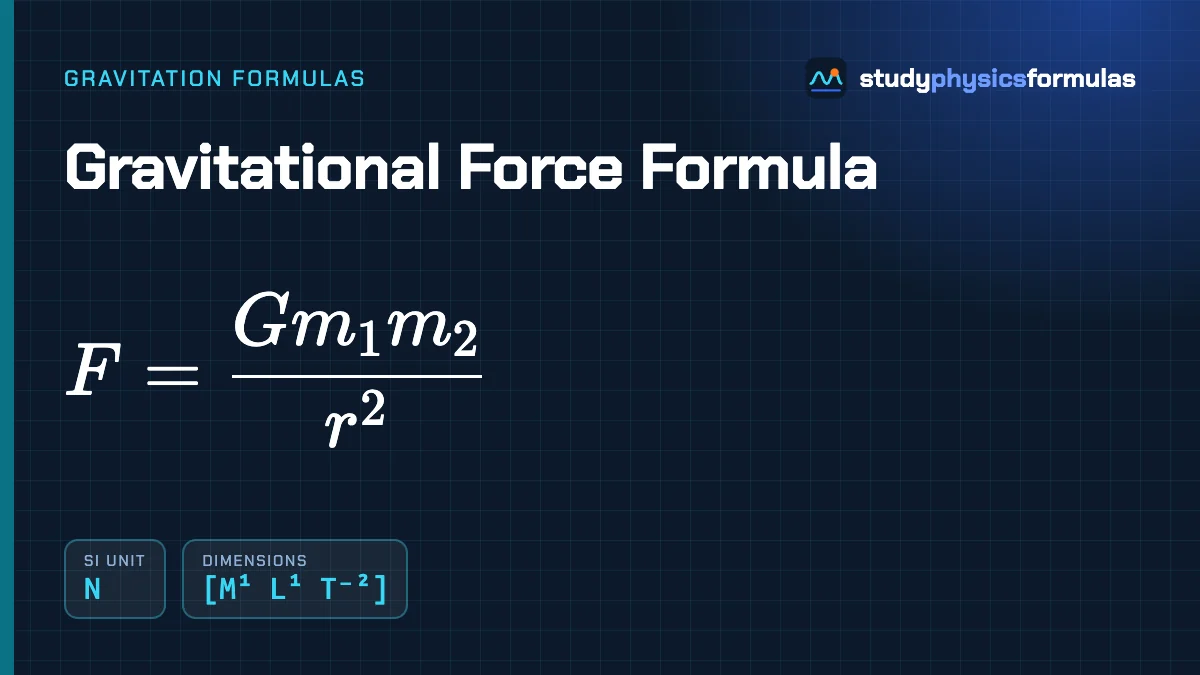
Quick facts
Formula
G
N m²/kg²SI unit of F
newton (N)Dimensional formula of F
[M¹ L¹ T⁻²]Nature
Always attractive, acts along the line joining the centresLaw type
Inverse square law, like Coulomb's lawNear Earth
with
The gravitational force formula, symbol by symbol
| Letter | What it is | Unit |
|---|---|---|
| Size of the attractive force on each body | N | |
| Universal gravitational constant, the same everywhere | N m²/kg² | |
| The two masses | kg | |
| Distance between the centres of mass, not the surfaces | m |
Three features matter in every problem. The force is mutual: Earth pulls you with the same size of force that you pull Earth, as Newton's third law requires. Its line of action runs through both centres. And it follows an inverse square: double r and F drops to a quarter, triple r and it drops to a ninth.
For spheres, the law works as if each mass were packed at its centre, provided you are outside the sphere. Inside a uniform hollow shell the net pull from the shell is zero. The tiny size of G is why you never notice the pull between two people, yet the huge mass of a planet makes its pull obvious. The dimensional formula of G page derives the units of G, [M⁻¹ L³ T⁻²].
Worked examples
Example 1: two students
Two students of 60 kg each sit 1 m apart. Find the gravitational force between them.
Far too small to feel; friction from the chairs is millions of times larger.
Example 2: Earth and Moon
Earth, mass 5.97 × 10²⁴ kg, pulls on the Moon, mass 7.35 × 10²² kg, from 3.84 × 10⁸ m away, centre to centre. How big is the pull?
Top line: . Bottom line: .
Example 3: ratio problem
Two masses attract with a force of 36 N. One mass is doubled and the distance is tripled. Find the new force.
. No constants needed.
From one law to the whole gravitation chapter
| Result | Formula | Full page |
|---|---|---|
| Surface gravity | Acceleration due to gravity | |
| Weight | Weight | |
| Gravitational potential energy | Potential energy | |
| Orbital velocity | Orbital velocity | |
| Escape velocity | Escape velocity | |
| Satellite period | Time period of satellite | |
| Dimensions of g | [M⁰ L¹ T⁻²] | Dimensional formula of g |
The concept map is short. Set the gravitational force equal to mg and you get g. Set it equal to the centripetal force and you get the orbital speed; divide the circumference by that speed and you have the period. Integrate the force from r to infinity and you get the potential energy, and setting total energy to zero gives the escape speed. Each step is a single line of algebra.
Gravity formula in physics: comparing with the electric force
Coulomb's law, written for two charges, is also an inverse square law, which is why the gravity force formula is so often compared with it. The differences are what examiners ask about.
| Feature | Gravitational | Electric |
|---|---|---|
| Depends on | Masses | Charges |
| Direction | Always attractive | Attractive or repulsive |
| Constant | ||
| Blocked by matter | No | Can be screened |
For two protons, the electric repulsion is about times the gravitational attraction. Gravity wins on large scales only because matter is nearly neutral overall, so electric forces cancel while masses always add. The electrostatic force formula page treats the electric side.
Study tips for gravitation
- Write GM = gR² on your rough sheet. It lets you swap between G and g in any orbit or escape problem.
- Use ratios. Most objective questions change one mass or one distance; F ∝ m₁m₂ / r² gives the answer without big numbers.
- Distances run centre to centre. A satellite h above the ground sits at r = R + h.
- Keep signs in energy. Potential energy is negative; total orbital energy is .
- Revise with a sheet. The Class 11 physics formulas, NEET physics formula sheet and JEE Main formula sheet pages group gravitation with the other chapters, and the AP Physics 1 formula sheet page covers the US course.
Exam traps with the force of gravity formula
- Using the distance between surfaces. r is between centres.
- Forgetting the square. Doubling the distance quarters the force; it does not halve it.
- Confusing g and G. g changes with place; G is a universal constant.
- Thinking the heavier body pulls harder. Each body feels an equal pull, the two pointing opposite ways.
- Saying there is no gravity in orbit. Astronauts are weightless because they are in free fall, not because gravity has vanished.
- Using F = mg far from Earth. Away from the surface, use the full law with r = R + h.
Rotation and circular motion results that pair with these, such as torque and angular momentum, are on the rotation and circles hub, and a planet's orbital angular momentum stays constant along its path.
Frequently asked questions
What is the formula of gravitational force?
F = Gm₁m₂ / r². Multiply the two masses, multiply by the constant G (6.674 × 10⁻¹¹ in SI units), then divide by the square of the centre to centre distance.
What is the formula of gravity near Earth's surface?
Near the ground, gravity's pull on a mass m is simply its weight, mg, with g about 9.8 m/s². This is the general law with g = GM/R² built in.
What is the formula for force of gravity between two planets?
Use the same law, F = GMm / r², with r the distance between the planets' centres. For Earth and the Sun it gives about 3.5 × 10²² N.
What is the formula for gravitational force in vector form?
Write F = −(Gm₁m₂ / r²) r̂, where r̂ is a unit vector from the first mass toward the second. The minus sign shows the pull on the second mass points back toward the first, so the force is attractive.
Why don't we feel the gravitational pull of nearby objects?
G is extremely small, so two everyday masses pull each other with forces around a millionth of a newton or less. Only a mass the size of a planet gives a pull we notice.