
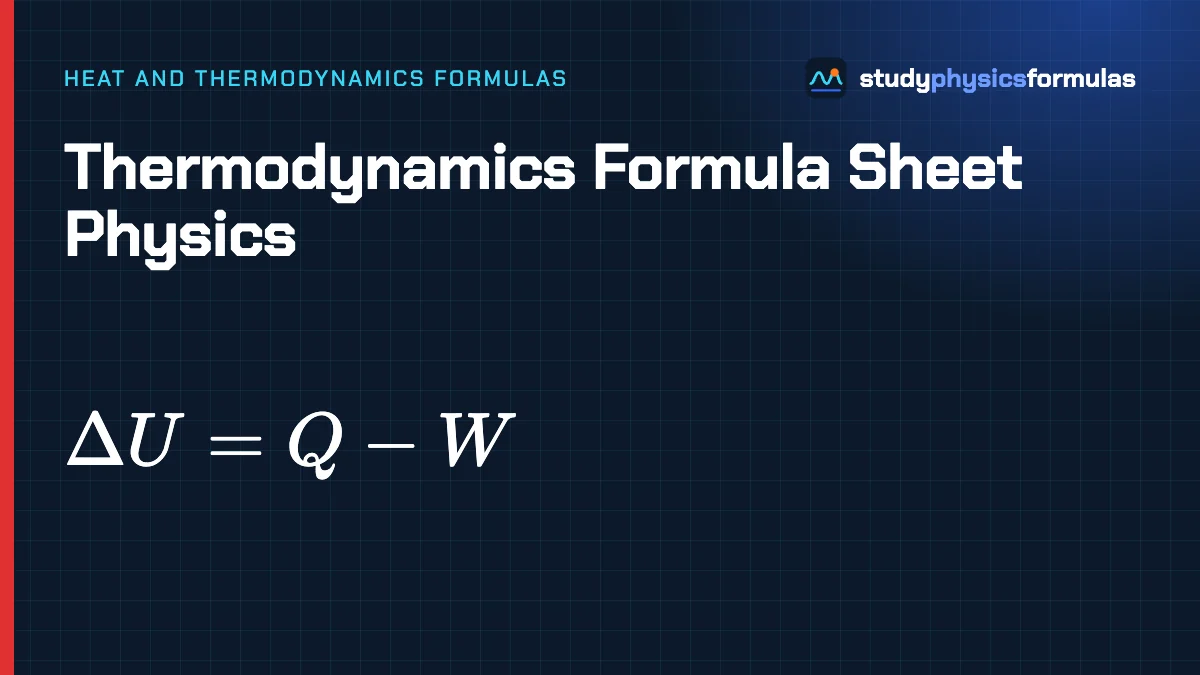
This thermodynamics formula sheet physics students can revise from gathers the heat and thermodynamics results of Class 11, AP Physics 2, JEE Main and NEET into tables, grouped the way the chapters are taught: temperature and expansion, calorimetry, heat transfer, kinetic theory, the laws of thermodynamics, and engines. The central relation is the first law, .
Treat it as revision notes rather than an official sheet. Exam boards that provide a formula sheet publish their own, and many tests provide none, so the definitions, the sign conventions and the conditions for each formula still have to be learned. Each formula below links to its own page wherever this site has one, with symbols explained and worked examples.
Quick facts
First law
Ideal gas
, R = 8.314 J/(mol K)Calorimetry
andConduction
Engine efficiency
(Carnot, kelvin)Boltzmann constant
k = 1.381 × 10⁻²³ J/KCourses
Class 11, AP Physics 2, JEE, NEET
Thermodynamics formula sheet physics overview: how the topics connect
Start with temperature, which tells you which way heat will flow. Heat that enters a body raises its temperature, by , or changes its state, by . Heat moves by conduction, convection and radiation, each with its own rate formula. For a gas, kinetic theory links temperature to the average energy of the molecules, and the ideal gas law ties pressure, volume and temperature together.
The first law then does the bookkeeping: heat in, work out, change in internal energy. Apply it to each standard process (isothermal, adiabatic, isobaric, isochoric) and you get the work and heat for each. The second law adds the final limit, that no engine can turn all its heat into work, and gives the Carnot efficiency.
Temperature, expansion and calorimetry
| Formula | What it gives | Unit |
|---|---|---|
| Kelvin from Celsius | K | |
| Fahrenheit from Celsius | °F | |
| Linear expansion | m | |
| Volume expansion | m³ | |
| Heat for a temperature change | J | |
| Heat for melting or boiling | J | |
| Principle of calorimetry for mixtures | J |
Full working for the heat equations is on the heat formula page. For areas, . Water has c ≈ 4186 J/(kg K), and ice has a latent heat of fusion of about 3.34 × 10⁵ J/kg.
Heat transfer
| Formula | What it gives | Unit |
|---|---|---|
| Rate of conduction through a slab | W | |
| Thermal resistance | K/W | |
| Newton's law of cooling | K/s | |
| Stefan's law for radiated power | W | |
| Wien's displacement law, b ≈ 2.898 × 10⁻³ m K | m |
See the thermal conductivity formula and Newton's law of cooling pages. In Stefan's law σ is the Stefan Boltzmann constant, 5.67 × 10⁻⁸ W/(m² K⁴), and T must be in kelvin.
Kinetic theory and the gas laws
| Formula | What it gives | Unit |
|---|---|---|
| Ideal gas equation, n in moles | Pa, m³, K | |
| Same law, N molecules | Pa, m³, K | |
| Gas pressure in kinetic theory, ρ the gas density | Pa | |
| Root mean square speed, M in kg/mol | m/s | |
| Mean kinetic energy per molecule | J | |
| Internal energy, f degrees of freedom | J |
The constants: R = 8.314 J/(mol K) and k_B = R/N_A = 1.381 × 10⁻²³ J/K; the dimensional formula of Boltzmann constant page derives its dimensions. Pressure itself is covered on the pressure formula page, and the molecular energy idea builds on the kinetic energy formula.
Example: moles and molecular speed
A cylinder holds 2.0 L of nitrogen at 1.0 × 10⁵ Pa and 300 K. Find the number of moles, then the rms speed of the molecules. Molar mass of nitrogen is 0.028 kg/mol.
V = 2.0 × 10⁻³ m³.
The speed does not depend on the pressure or the amount of gas, only on the temperature and the molar mass.
First law and thermodynamic processes
| Process | Rule | Work done by gas |
|---|---|---|
| Any | ||
| Isobaric | P constant | |
| Isochoric | V constant | |
| Isothermal | ||
| Adiabatic |
Heat capacities: per mole and , which is 5/3 for a monatomic gas and 7/5 for a diatomic gas near room temperature. The sign rules and worked examples are on the first law of thermodynamics formula page, and the general idea of work as force times displacement is on the work formula page.
Second law, engines and refrigerators
| Formula | What it gives |
|---|---|
| Efficiency of any heat engine | |
| Largest possible efficiency between two reservoirs | |
| Coefficient of performance of a refrigerator | |
| Ideal refrigerator | |
| Entropy change for reversible heat flow at constant T |
Example: an engine between two temperatures
An ideal engine works between 527 °C and 27 °C. Find its efficiency.
Convert to kelvin: T₁ = 800 K, T₂ = 300 K.
What to memorise and common traps
- Know your course's sign convention for W. Physics usually uses work done by the gas; some chemistry courses use work done on it.
- Convert litres to cubic metres (1 L = 10⁻³ m³) and kPa to Pa before using PV = nRT.
- Use kelvin in gas laws, radiation and efficiency. Celsius is fine only for temperature differences.
- Do not use Q = mcΔT during a change of state.
- Internal energy is a state function. Heat and work are path quantities, so two routes between the same two states can give different Q and W.
For the rest of the Class 11 syllabus see Class 11 physics formulas. Exam specific summaries are on the AP Physics 2 formula sheet, JEE Main physics formula sheet and NEET physics formula sheet pages. Dimensional checks for every quantity here are on the dimensional formulas hub, including the dimensions of thermal conductivity. The energy formula page covers the joule itself.
Frequently asked questions
What should a thermodynamics physics formula sheet include?
The heat equations Q = mcΔT and Q = mL, conduction and radiation laws, PV = nRT and kinetic theory results, the first law with the work for each process, and engine and refrigerator efficiencies.
Is this the official exam formula sheet?
No. These are revision notes put together for practice. Where a board supplies a sheet, it prints its own, so practise with that one too.
Which single formula matters most in thermodynamics?
The first law, ΔU = Q − W. Most process questions start from it.
Which thermodynamics formulas are in Class 11 physics?
Thermal expansion, calorimetry, conduction, Newton's law of cooling, Stefan's and Wien's laws, kinetic theory of gases, the first law, the four standard processes and the Carnot engine.
Why must temperatures be in kelvin in gas law and efficiency formulas?
These formulas use ratios or products of absolute temperature. Only the kelvin scale starts from absolute zero, so Celsius values give wrong results.