
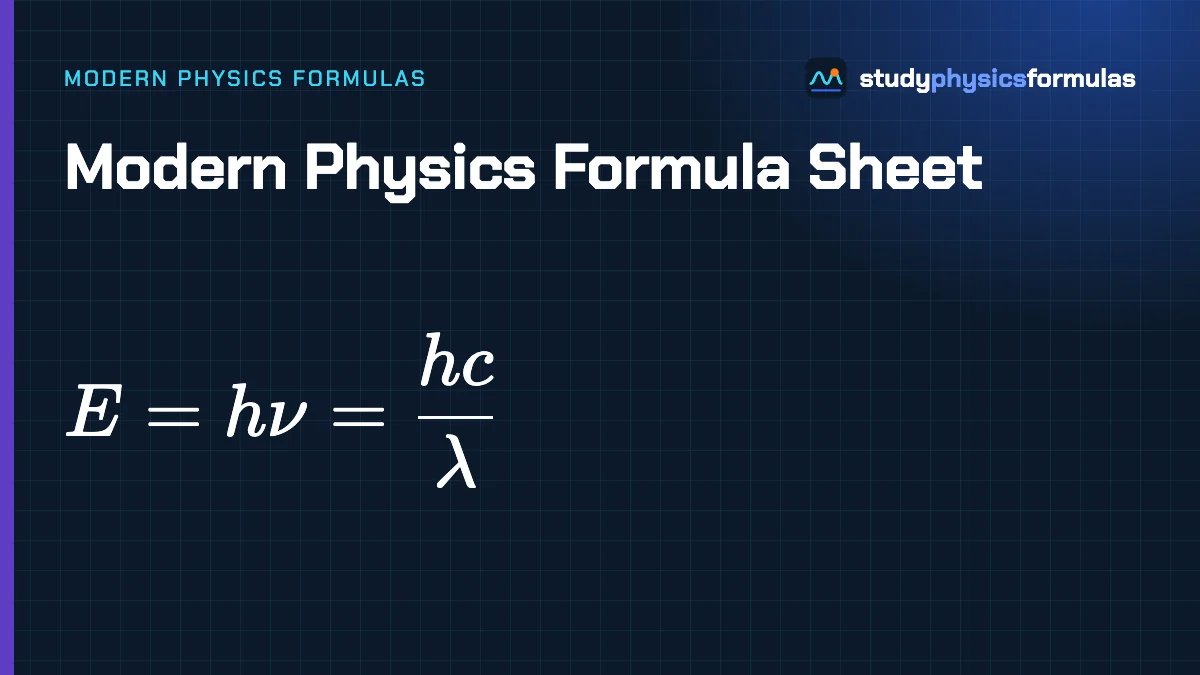
This modern physics formula sheet collects the results that describe light as particles, matter as waves, the structure of atoms and nuclei, and motion near the speed of light, all starting from the photon relation . It covers the dual nature, atoms and nuclei chapters of Class 12 physics, the modern physics part of JEE Main and NEET, and the quantum and nuclear unit of AP Physics 2.
Please treat it as a study summary, not an exam document. Official formula sheets, where an exam supplies one, come from the exam board, and many Indian exams give no sheet at all, so you must learn these by heart. Each table row links to a page with the symbols, a derivation where boards ask for one, worked examples and a calculator.
Quick facts
Photon energy
Photoelectric equation
Matter wave
Hydrogen levels
eVDecay law
Mass energy
, 1 u = 931.5 MeVHandy constant
hc = 1240 eV nm, so E (eV) = 1240 / λ (nm)
How the modern physics formula sheet fits together
Almost every formula here is either a quantum rule or an energy balance. Follow the chain:
- Light comes in packets. A photon of frequency ν carries and momentum .
- Photons free electrons. The photoelectric equation is energy conservation for one photon and one electron.
- Particles behave as waves. The same relation p = h/λ, read the other way, gives a wavelength to any moving particle.
- Atoms have fixed levels. Quantised angular momentum fixes the orbits and energies in hydrogen, and jumps between levels make spectral lines.
- Nuclei store mass as energy. Binding energy and decay follow from and a simple probability law.
Two energy units run through every chapter. Use joules in SI work and electronvolts for atoms, 1 eV being 1.602 × 10⁻¹⁹ J. Many errors come from switching between the two halfway through a question.
Photons and the photoelectric effect
| Formula | What it gives | Unit |
|---|---|---|
| Energy of one photon, see the energy formula | J or eV | |
| Momentum of a photon, linked to the momentum formula | kg m/s | |
| Work function from the threshold | J or eV | |
| Fastest photoelectron energy | J or eV | |
| Stopping potential link, see the voltage formula | V for V₀ | |
| Shortest X ray wavelength from a tube at voltage V | m |
Frequency and wavelength are tied by ; see the wavelength formula and frequency formula pages if you need a refresher. The value of c is on the speed of light formula page. The full chapter, with intensity and photon flux, is on the dual nature chapter sheet.
Matter waves
| Formula | What it gives | Unit |
|---|---|---|
| Wavelength of any moving particle | m | |
| Same, from kinetic energy K | m | |
| Particle of charge e after a potential difference V | m | |
| nm | Electron accelerated through V volts | nm |
The last row is the second one with the electron's mass and charge already put in, so it only works for electrons and gives nanometres. For a proton or an alpha particle, go back to with the right mass and charge. A heavier particle at the same kinetic energy has a shorter wavelength. The unit check for all of these runs through the dimensional formula of Planck's constant, [M¹ L² T⁻¹].
Atoms: scattering, Bohr's model and spectra
| Formula | What it gives | Unit |
|---|---|---|
| How near a head on alpha particle gets, the closest approach | m | |
| Bohr's quantisation of angular momentum | J s | |
| Å | Radius of the nth orbit | Å (10⁻¹⁰ m) |
| Electron speed in the nth orbit | m/s | |
| Energy of level n | eV | |
| Wavelength of a line, R = 1.097 × 10⁷ m⁻¹ | m⁻¹ | |
| Number of spectral lines from level n | no unit | |
| Orbital angular momentum of an orbital | J s |
The closest approach result is plain Coulomb energy; the electrostatic force formula and potential energy formula pages supply the background. In Bohr's model the kinetic energy of the electron equals −E_n and the potential energy equals 2E_n, a ratio that turns up in many one mark questions. Electrons also have spin angular momentum, which the orbital formula does not include.
Nuclei and radioactivity
| Formula | What it gives | Unit |
|---|---|---|
| Nuclear radius, R₀ ≈ 1.2 fm | m | |
| Mass defect of a nucleus | u or kg | |
| Binding energy; 1 u gives 931.5 MeV | J or MeV | |
| Undecayed nuclei after time t | no unit | |
| Half life | s | |
| Mean life | s | |
| Activity, the decay rate | Bq (decays per second) |
Because , the volume of a nucleus is proportional to A and nuclear density comes out roughly the same for every element. After n half lives the fraction left is : three half lives leave one eighth. The decay constant λ here is not a wavelength, so write it clearly in your working.
Special relativity
| Formula | What it gives | Unit |
|---|---|---|
| Rest energy of a mass, linked to the mass formula | J | |
| Lorentz factor | no unit | |
| Time dilation | s | |
| Length contraction | m | |
| Energy and momentum together | J |
Most school syllabi need only the mass energy relation for nuclear binding. College courses and some advanced school courses also use γ. For any speed below about a tenth of c, γ stays within half a percent of 1, so Newtonian answers are fine.
Study tips and exam traps
- Learn hc = 1240 eV nm. It turns most photon questions into one division. Remember it needs λ in nm.
- Keep units in one system. Either all SI or all eV with nm. Mixing gives answers off by 10⁻¹⁹ or 10⁹.
- Intensity changes the number, not the energy. Brighter light gives more photoelectrons per second, but the same K_max.
- Check the sign of E_n. Bound levels are negative. Ionisation energy from level n is +13.6Z²/n² eV.
- Single atom or sample. One atom from level n gives at most n − 1 lines; a sample gives n(n − 1)/2.
- Use 931.5 MeV per u. It saves converting masses to kilograms.
- Half life is not half the mean life. T½ = 0.693τ.
Beyond this chapter, the whole syllabus is collected on separate sheets: Class 12 physics, JEE Main physics, NEET physics and AP Physics 2.
Frequently asked questions
What does a modern physics formula sheet include?
It usually covers photon energy and momentum, the photoelectric equation, de Broglie wavelength, Bohr's model of hydrogen with its energy levels and spectral series, nuclear radius, binding energy, radioactive decay and the mass energy relation E = mc².
Can I use this page in place of the exam board sheet?
No, this page is a revision aid. Any official sheet comes from the exam board, and most Indian board and entrance exams expect you to remember these formulas.
Which single formula matters most in modern physics?
E = hν is the base of most of the chapter. Together with p = h/λ and E = mc² it explains the photoelectric effect, matter waves, atomic spectra and nuclear energy.
What is the value of hc in eV nm?
hc is about 1240 eV nm (1239.8 to four figures). Dividing 1240 by a wavelength in nanometres gives the photon energy in electronvolts.
Which modern physics formulas come up most in JEE and NEET?
Students meet the photoelectric equation, de Broglie wavelength, Bohr's energy levels, the number of spectral lines, half life and binding energy again and again in practice papers. Learn the conditions for each, not just the formula.